 Open Historia
The Advisor
Your in-game analyst: asking questions about your real position, reading charts, and turning advice into orders.
The advisor is an analyst that can see your actual game state. Ask it anything about your position and it answers about your position, not about grand strategy in general.
Open it with the Advisor button in the bottom-right corner. Drag the drawer's left edge to resize it; the width is remembered.
What it is good for
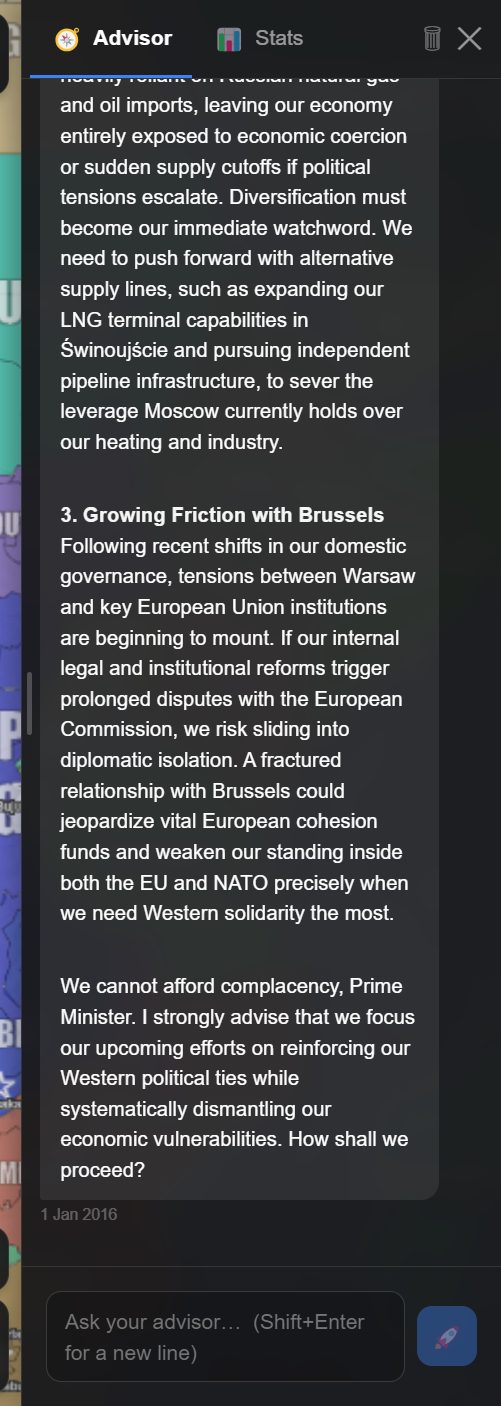 The advisor reads the real game state — here, Poland's energy exposure and its friction with Brussels.
Orientation. The fastest way to understand a country you have just picked up:
What are the three biggest risks to Poland right now?
Interpretation. You can read your own stat sheet, but the advisor can tell you what the combination means:
My food autonomy is 32 and my debt is rising. How exposed does that make me if the Black Sea corridor closes?
Assessment of other people. It reads the whole world, not just you:
Who is most likely to move against me in the next year, and what would the first sign be?
Deciding what to order. It is genuinely good at turning a vague worry into a specific policy, which is exactly the gap that makes orders work or not.
I want to reduce my dependence on Russian gas without wrecking industry. What are my options over the next two years?
Charts
The advisor answers in markdown, and it can include charts. When a question is better answered with a picture — a trend, a comparison across countries, a breakdown — it renders one inline rather than listing numbers.
You can ask for one directly: "chart my GDP growth against my neighbours'".
What it is not
It is not an oracle. It reasons from the same world state you can see. It does not know what other countries have secretly decided, and it cannot see through your opponents' intentions any better than the information available to you allows.
It is not privileged intelligence. For what other countries are actually saying in private, you need espionage. The advisor works from the public picture, your own records, and the documents your government holds — it knows everything you know and nothing more.
It does not act on the world. Nothing the advisor says moves a border, signs a treaty or resolves a war until a time skip does it. It can write to your order queue and your projects board on your behalf — see asking it to do the paperwork below — but even then it is filling in your plans, not executing them.
It is only as good as your model. The advisor is one of the most reasoning-heavy things in the game. On a small local model its answers get noticeably thinner. See AI providers and models.
Asking it to do the paperwork
The advisor can write straight into your order queue and your projects board. Ask it in plain language:
"Draft me the orders for a phased withdrawal from the eastern border."
"Open a project for the rail modernisation we discussed, and close the one on port dredging — that finished last year."
Its reply arrives as normal, and underneath it you get a receipt card for each thing it touched: a 📋 Actions card and a 🏗 Projects card, each listing exactly what changed with a button through to the panel itself.
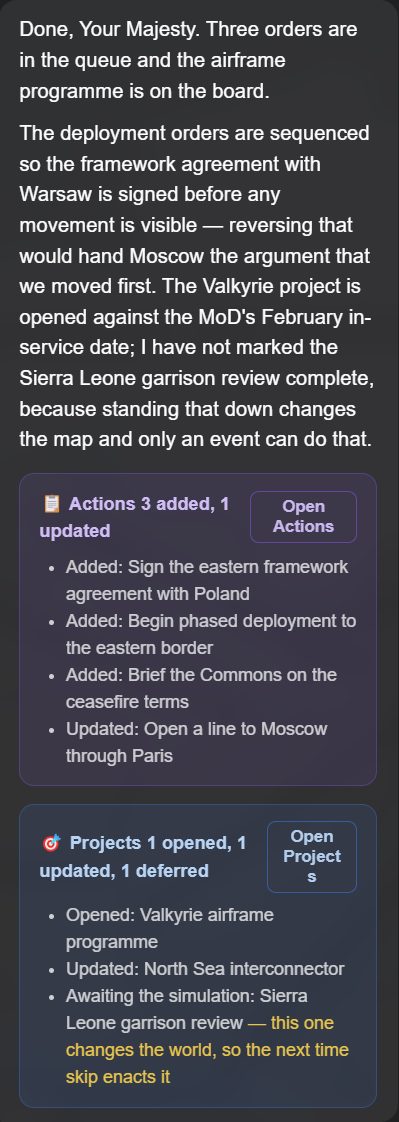 Three orders queued, one rewritten, a project opened and another updated — each card lists
exactly what changed and links to the panel. The amber line is the one thing it would not do
itself.
Three orders queued, one rewritten, a project opened and another updated — each card lists
exactly what changed and links to the panel. The amber line is the one thing it would not do
itself.
A few things worth knowing about how this behaves:
- It applies immediately. There is no confirm step. The card is a receipt of what already happened, not a proposal waiting for your approval.
- Orders are queued, not executed. Anything it adds lands in the queue as planned, exactly like an order you typed yourself, and waits for the next time skip. You can edit or delete it first. See giving orders.
- It can remove and rewrite, not just add. The cards distinguish added, updated and removed so you can see which it did.
- It cannot itself finish a project that would change the world. Completing something that moves a border or renames a country is the simulation's job. The card says so — "Awaiting the simulation … this one changes the world, so the next time skip enacts it" — rather than quietly doing nothing or claiming it finished.
It can also draft for you:
- Letters. A reply can carry a draft to a foreign government; ✉️ Draft to France puts it in that country's thread, ready for you to read and send.
- Deployments. A recommended deployment comes with 📍 Place … here, which places it on the map with one click — an intention, like any order, until the next skip.
The habit that makes this useful is treating it as dictation. Talk through the situation, then ask it to write up what you both concluded — and read the cards before you skip.
It keeps up with the world
It knows what changed. When you come back to the advisor after the world has moved on, your next question carries a short note of what happened since — the newest events, what became of its own last suggestions, and any changes made from the cheats panel — so it does not answer as though it were still last month. Until the event reveal reaches an event, the advisor does not know of it either.
It knows your standing goal. Set one in the Actions panel and the advisor weighs its advice by it, and says plainly when an order works against it.
Papers arrive here. When a document reaches your government — a letter through diplomacy, a copy an agent stole, a secret annex on an event — a line appears in the advisor's conversation: 📄 A new paper on your desk, with Read it and Put it away. It is a notice, not a message to the model, and an undone turn takes it back.
A failed answer can be retried. It shows the provider's error, a button to save the logging file, and Retry, which asks the same question again. See troubleshooting.
On beta the advisor reads your stat sheet and the world's ledgers — wars, relations, agreements — so it answers from your actual figures rather than estimating them.
Clearing it
The 🗑 button clears the conversation. Worth doing when you move into a genuinely new phase of a campaign and the old thread is no longer the context you want.
Where it sits
The advisor drawer shares its space with the Stats tab — the numbers on one side, someone to interpret them on the other. See national statistics.
Next
- National statistics — the sheet the advisor is reading.
- Giving orders — acting on the advice.
- AI providers and models — what governs answer quality.
Open Historia is under active development on two channels, and this
wiki is written by hand — a page can fall behind a release. Last checked against the game on 2026-09-24 · main e62a1c55 · beta 2f48a6c2. If something
here does not match what you see in the game, trust the game and
say so on Discord.