 Open Historia
Projects and Operations
Long-running efforts that span turns: research programmes, construction, covert operations and campaigns.
Some things a country does cannot happen in one turn. A nuclear programme, a canal, a rearmament plan, a decade-long insurgency, a covert operation to destabilise a neighbour — these are efforts, not actions, and they get their own board.
Open it with the Projects & Operations button in the toolbar, alongside Chat and Actions. A new campaign's board is empty — "Nothing on the board yet" — until events and your advisor start writing to it; 🧭 Ask your advisor to populate this gets it to file the efforts you already have under way.
This is also where research and technology live. There is no tech tree; there is a research programme with milestones that either progresses or stalls.
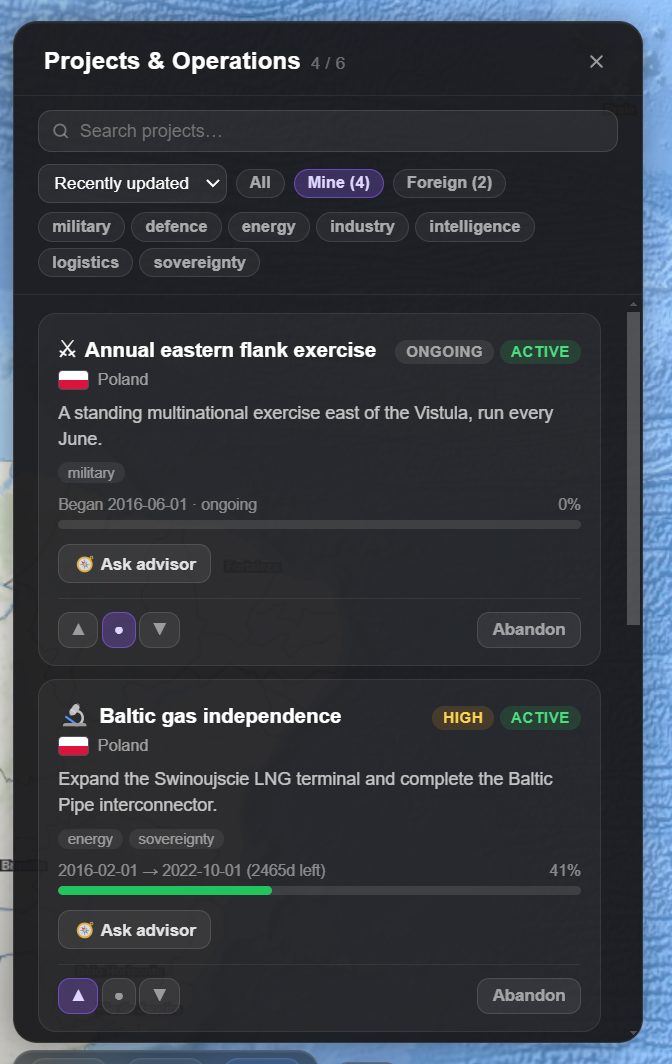 *A board on a campaign that has been running a while. Note the counts — Mine (4),
Foreign (2) — the tag chips, the priority control on each card, and that an ongoing effort
carries no target date and so can never run late.*
*A board on a campaign that has been running a while. Note the counts — Mine (4),
Foreign (2) — the tag chips, the priority control on each card, and that an ongoing effort
carries no target date and so can never run late.*
Projects and operations
Two kinds:
- Projects — construction, research, industrial and political programmes. Building something, generally.
- Operations — military and covert undertakings. Doing something to someone, generally.
Each carries a status:
| Status | |
|---|---|
proposed |
Suggested, not yet under way |
active |
Running |
stalled |
Running, but not moving |
paused |
Deliberately halted |
complete |
Finished successfully |
failed |
Finished unsuccessfully |
cancelled |
Abandoned |
The first four are open and appear on the default board. The last three are closed and live behind a separate view.
Secrecy
public |
Everyone can see it |
🔒 restricted |
Known, but not openly |
🕵 covert |
Hidden |
A covert operation you can see on your own board is not visible to the country it targets — unless their intelligence service finds it.
Milestones
A project carries up to 8 milestones, each dated and either pending, done or missed. The next pending one is what the board shows you as the thing to watch.
Milestones can repeat — weekly, monthly, quarterly, annual or biennial. Marking a repeating milestone done advances it by one interval from its own date, so an annual exercise on 1 June stays on 1 June rather than drifting. A missed occurrence is deliberately not rolled forward: it stays pending and is flagged as missed, because a drill you skipped is a fact about your country, not a scheduling inconvenience.
A project marked ongoing is a standing effort with no planned end. It has no target date and can never be overdue.
What you actually control
Two things, and this is deliberate:
Priority. high, normal or low. High means the advisor briefs it first and the
simulation is told to keep it moving. Low means it is allowed to drift.
Abandoning it. Which routes through cancellation — the project stays on the board under Closed, with the progress it actually reached.
You do not author a project's content. Projects are written by the world — by events, by your intelligence service, and by the advisor — in response to what your country is doing. You steer them; you do not type them into existence.
After each time skip the board is brought into step with what happened — progress, stalls and new long-term efforts — reading every event of the turn, including ones taken off the timeline as filler. With Save AI requests on, this shares the one after-skip request; it can be turned off in Settings → AI. If that update fails, the turn is held rather than lost — see troubleshooting. The time skip itself is shown the board, so an effort you push is narrated as what it actually is.
On beta a project's activity lists only the events that moved it, rather than every event that mentioned it in passing.
Closing keeps the record. Completing marks pending milestones done and forces progress to 100%; failing or cancelling marks them missed and preserves the real progress reached. Only an explicit delete erases a project entirely.
Completion has consequences
A project can carry changes that release only on successful completion — never on cancellation, never on failure. This is how a five-year programme to build up your intelligence service actually raises your rating: not gradually, but when it finishes.
It is also why abandoning a project at 90% gets you nothing except the record that you tried.
Foreign projects, and whether to believe them
The board shows projects belonging to other countries too, when your intelligence tells you about them. Those carry a verification state:
| Badge | Meaning |
|---|---|
| (none) | Learned openly; the ordinary case |
| Doubtful | The agent it came from is compromised |
| Confirmed | Corroborated by a clean source |
| Fabricated | Established as false |
The loop this creates is the best thing on the board. A turned agent feeds you planted material. A foreign project opens on your board from it. Later, your counter-intelligence realises that source was compromised, and the entry is stamped Doubtful — the engine can raise the doubt but it cannot settle it.
The only way to resolve it is to get a fresh agent into that country and look again. Until you do, you are planning against something that may not exist.
Limits
| Projects | 120 |
| Milestones per project | 8 |
| Linked events per project | 12 |
The board warns you when you are within ten of the project limit. Past it, finished work is evicted first, oldest by last update — your active programmes are never dropped to make room.
Filtering
The board filters by owner (yours or foreign), free text, and tag chips, with several sort orders and a separate Closed view. On a long campaign with a busy intelligence service you will need them.
Next
- Espionage — where the foreign entries and the doubt come from.
- Giving orders — how efforts get started.
- Relations, treaties and war — the ledgers the board sits beside.
Open Historia is under active development on two channels, and this
wiki is written by hand — a page can fall behind a release. Last checked against the game on 2026-09-24 · main e62a1c55 · beta 2f48a6c2. If something
here does not match what you see in the game, trust the game and
say so on Discord.