 Open Historia
Diplomacy
Talking to other countries: leader voices, group threads and polls, memory, reactions and unprompted approaches.
Diplomacy is a conversation, not a menu. There is no "propose alliance" button and no accept/decline dialog. You open a chat with a country and talk its leader into something, or fail to.
Find it in the Chat panel, Diplomacy tab — Start New Chat to open a thread — or with 💬 on the card when you click a country on the map.
Talking to a country
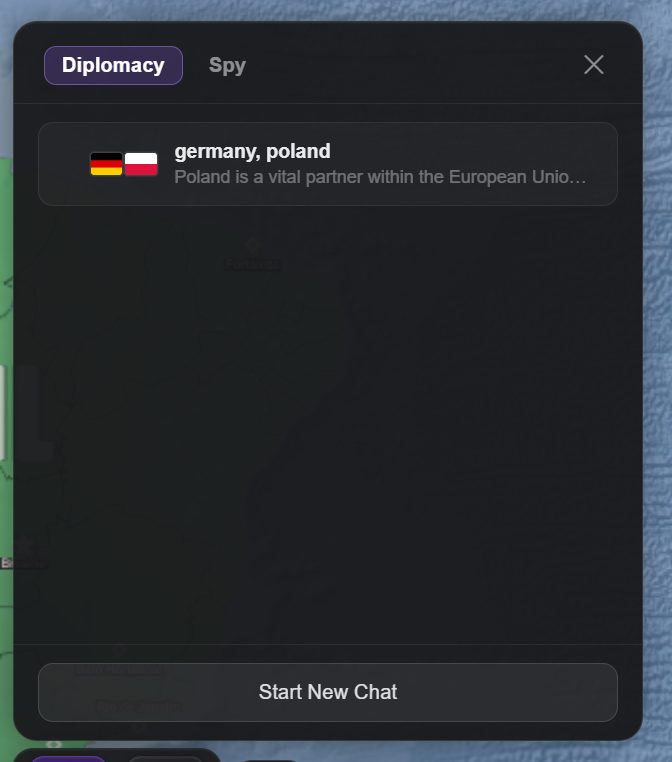 Threads you are part of. Germany opened this one unprompted after a time skip.
Every country is played by its leader, in that leader's voice, shaped by their country's situation and by how they see you. Ask questions, make offers, issue threats, propose terms.
What works is roughly what would work on a real government:
- Offer something. A demand with nothing attached gets refused by anyone who can afford to.
- Be concrete. "Let's cooperate" goes nowhere. "Preferential grain transit in exchange for your vote at the UN" is a proposal someone can answer.
- Know who you are talking to. Read their panel and ask for the advisor's report first. A country in crisis wants different things from a confident one.
- Follow up. Agreements reached in conversation become real through subsequent events and orders, not the moment the words are said.
Leaders remember
Each country keeps its own private summary of its dealings with you, carried between conversations and fed back as context. A leader you threatened ten turns ago has not forgotten it, and neither has one you kept a promise to.
This is separate from the world's event history. The event log records what happened; the diplomatic memory records how that country feels about you because of it.
They know what has happened since. A thread can sit for months of game time. When you write into it after the world has moved on, your message carries a short note of what happened on the public record since the thread last spoke — the newest events, borders moved, countries renamed, founded or dissolved. Your bubble shows it as one small line, "⏳ Since 1 December 2015 · 3 events · 1 border change", with the whole note on hover. Only what is public goes in it: a leader learns secrets through its own threads, not yours.
Reactions
Leaders attach an emoji to your last message — a small, immediate read on how what you just said landed, before their actual reply arrives. It is a genuinely useful tell when you are probing.
Group conversations
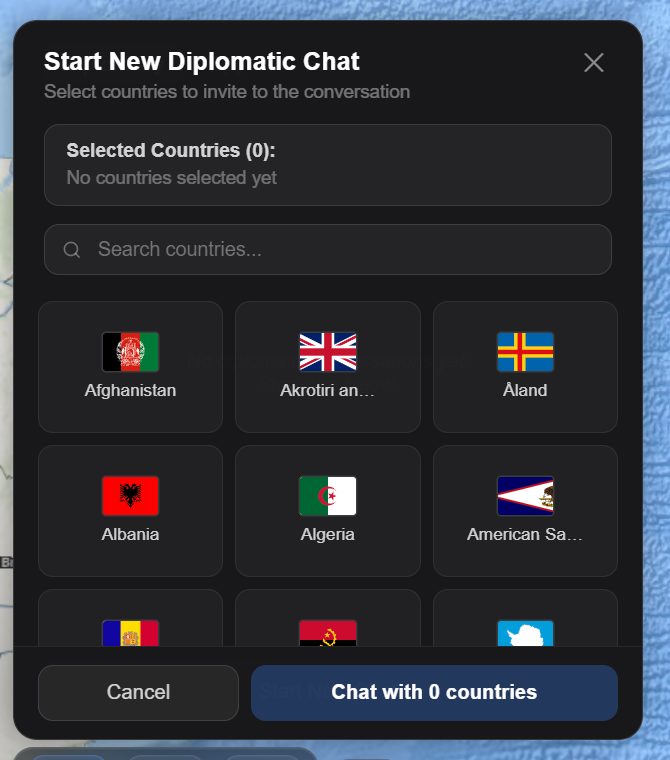 Starting a thread. Select as many countries as you want in it — one for a private line, several
for a summit.
Starting a thread. Select as many countries as you want in it — one for a private line, several
for a summit.
You can open a thread with several countries at once. When you speak, one request answers for the whole table: every other participant can reply, react, rename the thread, bring someone in or show someone out, and call or answer a poll. The lines are said one at a time — each speaker is seen typing for a few seconds before its line appears — and you can cut in: speak before the table has finished and the lines not yet said never are, and the next turn knows who was interrupted.
A poll in a thread is binding: every AI participant votes in the same turn, and you can see the question, the options and the votes, and cast your own.
Each country hears only what was said while it was in the room: a power brought in on turn six is not written as though it heard turn two. What a leader heard in its own other threads, it may bring with it.
Group threads are where multi-party diplomacy actually happens: mediating between two rivals, assembling a coalition, or being ganged up on.
They contact you
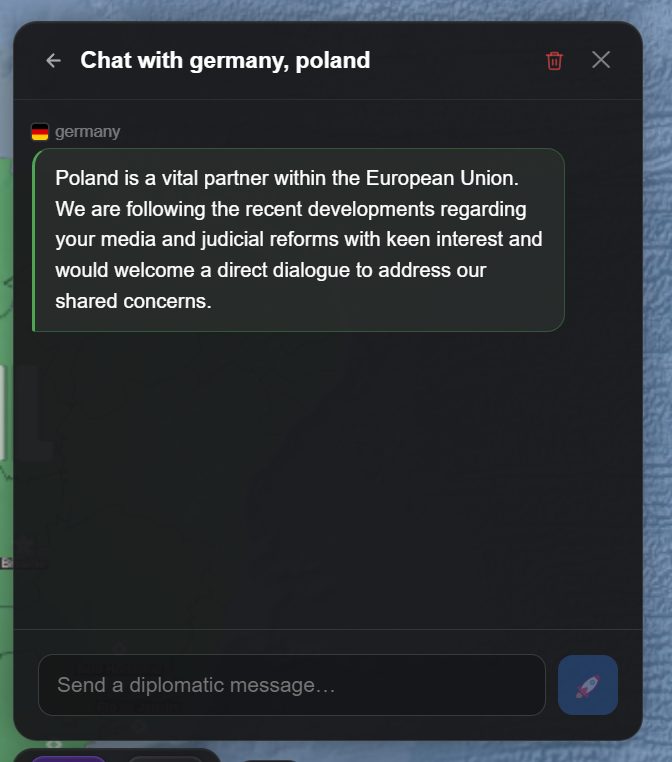 Germany's opening message, in its government's voice and grounded in what the world had just done.
Countries open conversations with you on their own initiative, in three ways:
Because of an event. A border incident produces an ultimatum, a war scare produces an offer of mediation, a windfall produces a trade delegation. The other side always speaks first.
As general outreach. Treaty feelers, non-aggression proposals, warnings, summit invitations — approaches that are not tied to any single event.
The simulation is told to write these only when some country plausibly would — an approach has to serve the sender's interests — so a quiet turn brings none.
Unprompted, while you play. On average every eight minutes of real time while the game is on screen, the model is asked whether some country with a live reason to speak would write to you; most of the time nobody does. It never fires during a time skip or while events are still being revealed. Each attempt is a request nobody pressed a button for, so it only runs while Background AI is on (Settings → AI → AI requests), and stops at its daily cap. A scenario can change the cadence, or switch it off, with its Idle diplomacy feature.
A document can arrive this way too: a paper held by you and other governments reaches you as a note in the thread with them, spoken by whoever sent it.
You are told when they write. A message that lands while its thread is not on screen raises a toast (click it to open the thread), an optional two-note chime (the 🔊 toggle), and a 🔔 notification centre until you open the panel; desktop notifications can be allowed too. Unread threads are badged. Answering them is most of the game's texture — a campaign where you never reply is a much smaller campaign.
The world cannot sign for you
This is an explicit rule the simulation is held to: no other country can commit you to anything.
The world may not sign treaties, alliances, ceasefires, surrenders, trade pacts or unions on your behalf, may not accept or reject offers for you, and may not have your country take landmark unilateral action — declaring war, ceding territory, changing government — unless it is directly executing an order you actually gave.
When another country wants such a decision from you, it has to ask: as a chat where they speak first and make the proposal, or as an event describing the offer as open and awaiting your answer.
So if you find yourself in an alliance, you agreed to it. Events remain free to narrate whatever other countries do among themselves.
Turning talk into outcomes
A conversation on its own changes attitudes. To change the world, pair it with an order:
In chat: talk Germany into backing a joint force on the eastern border. In the queue: "Formalise the joint eastern deployment agreed with Berlin and begin stationing troops."
The chat establishes that they are willing; the order is you acting on it. Doing only the first tends to produce a campaign where everyone likes you and nothing happens.
Reading everyone else's diplomacy
The Spy tab of the same panel shows conversations you are not part of, as far as your intelligence service can read them. That is a whole system of its own — see espionage.
The ledgers behind the talk
Conversations sit on top of explicit ledgers: numeric relation scores between every pair of countries, a formal register of treaties and their status, and a war ledger that is the single authority on who is fighting whom. See relations, treaties and war.
You read them from the 🤝 Diplomacy block on any country's stat sheet — every bilateral score that country holds, its treaty register and its current wars, for anyone you click on the map. Checking a country's existing friendships before you open a thread with them changes how you play.
On beta, an overlord can make demands. In the one-on-one thread between a puppet and its overlord, a message can be a demand, answered on a card with Accept, Refuse or an alternative — and only a refusal costs the puppet loyalty.
Next
- Espionage — reading what is said when you are not in the room.
- Giving orders — acting on what you agreed.
- Countries and identity — reputation, tags, and who you are dealing with.
Open Historia is under active development on two channels, and this
wiki is written by hand — a page can fall behind a release. Last checked against the game on 2026-09-24 · main e62a1c55 · beta 2f48a6c2. If something
here does not match what you see in the game, trust the game and
say so on Discord.