 Open Historia
Territory: Control and Claims
Who holds the ground and who says it should be theirs — two separate things, drawn differently on the map.
The map is divided into regions. Every region has someone who administers it, and possibly other countries who say it should be theirs. Those are two different things, and the map draws them differently.
Control
Whoever administers a region owns it as far as the map is concerned: the region is painted in their colour, it counts as their territory, and their units sit on it without asking.
Control moves when an event says it moves. That is the only route. A time skip produces an event narrating a conquest, an annexation, a treaty cession or a peaceful hand-over, and the border change ships attached to that event. There is no separate "conquer" button, and no event can describe territory changing hands without actually changing it — the narration and the mechanical change are the same object.
After the skip, the game checks the turn's wording against the map: a place an event names in plain words — a city, an alias, a region — is found on the scenario's actual geography, captured towns change hands, and contested ones are striped. With Save AI requests on this is part of the one after-skip check. Ground handed to a country that does not exist yet founds it.
A scenario can also set a tempo for the map — at most so many regions changing hands per 30 days. A skip that moves more than that has the rest held back, and the next skip is told the front moves this far and to carry the rest on.
You can also move control by hand from the cheats panel, which is the game-master route rather than the gameplay one.
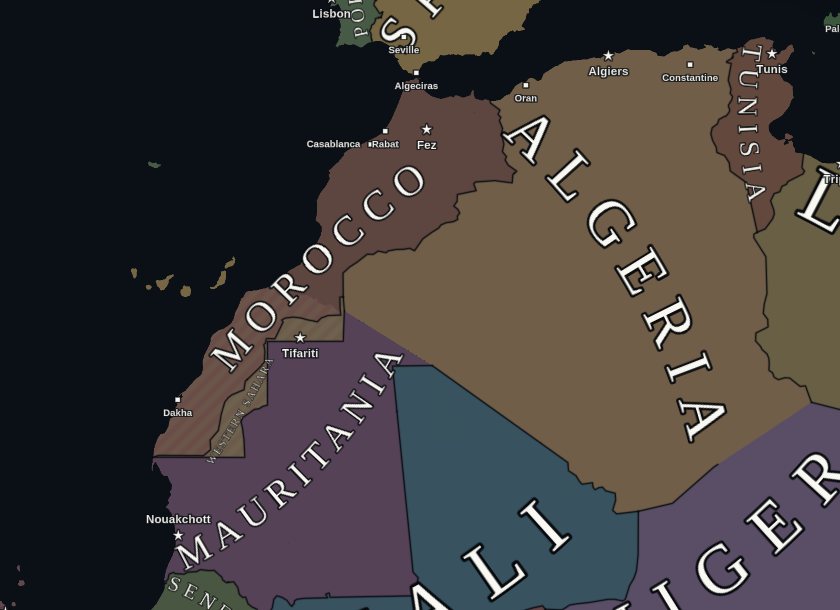 Western Sahara, between Morocco and Mauritania, drawn in faint diagonal stripes — a region more than one country claims.
Claims and disputes
A region can carry a list of claimants — up to four countries that assert it is theirs.
A region with claimants is disputed, and it renders striped: the administrator's colour combined with each claimant's. This is how you read a contested border at a glance.
Claims are their own layer. They do not affect who administers the ground, they do not change what your units can do, and they are not a countdown to anything. They are the game's record of who is aggrieved — and a standing invitation for the world to do something about it.
Claims are added and withdrawn the same way control moves: through events. If you want a claim recognised or dropped, that is a diplomatic outcome you have to argue for.
Scenario authors can also mark disputes directly when drawing a map. World-level claims override whatever the scenario's geometry says, so a campaign can develop new disputes over time without the underlying map being edited. A dispute that ends stays ended on the map.
Playing the difference
The gap between control and claim is most of what makes borders interesting.
- Taking ground does not settle it. Conquering a claimed region leaves the claim standing; the previous holder still says it is theirs, and so does the map.
- Claims are diplomatic leverage. A neighbour with a live claim against a third country is a neighbour with a reason to work with you.
- Dropping a claim is a real concession and can be traded for something. It is one of the more valuable things you can offer in a negotiation, because it costs you nothing material and costs your pride a great deal.
- Stripes on your own territory are a warning. Someone is building a case.
Regions and owners
A region's owner is a country with one stable identity. Renaming a country changes its label, not who it is: every region, flag, tag, colour, war record and standing goal follows it, so a country does not split in two the turn after it is renamed. In the map editor, typing a country name that does not exist yet brings that country into existence. See countries and identity.
The Region Inspector in the cheats panel inspects any region — who controls it, who is sovereign, who claims it, its name and properties — and lets you edit control and make legal transfers.
What territory does for you
Territory is not a resource you spend. There is no per-province income to collect and no buildings to place on it. What it gives you is:
- Standing. A larger, more coherent country is treated as a more consequential one.
- Position. Units act within era-appropriate ranges; where your border is determines what you can reach.
- Statistics. Population, economy and the strategic indices reflect what you hold. See national statistics.
- Grievances. Yours and other people's.
Losing territory is correspondingly not a stockpile draining — it is a country becoming less consequential, more surrounded, and more likely to be pushed further.
Landless countries
A country can hold no territory at all and still exist, act and be talked to — governments in exile, movements, organisations. You can play one. See countries and identity for how they work.
The sovereignty layer
Between control and claims sits a third layer. The game separates control (who administers the ground) from sovereignty (who lawfully owns it), so occupation, exiled governments and unrecognised annexations are all representable: "control is not sovereignty".
Sovereignty is stored sparsely — ordinary territory has no entry, because control and sovereignty agree. A row appears only where they diverge, which is exactly the interesting case.
Three explicit operations move control without touching who lawfully owns the ground:
| Operation | |
|---|---|
contest |
Mark the ground as fought over |
control |
Hand de-facto administration to someone |
clear_contest |
Settle it again |
Each can be applied to a single region or to a country's whole territory at once. Transferring lawful sovereignty is a separate act — that is what a treaty does, and it is why an occupation can run for years without the map ever conceding the point.
The Region Inspector shows all three layers for any region, plus how each came to be that way, and the map shows the displaced controller and sovereign on contested and occupied ground. A wartime capture is recorded as a change of control, not a cession.
On beta, a puppet is not a fact about land. A puppet keeps its own territory and sovereignty; subordination lives in its own ledger. And a structure an event credits to a country with no land goes to whoever holds the ground it stands on.
Next
- Military and combat — taking ground.
- Relations, treaties and war — the ledgers that formalise who is fighting whom.
- The map editor — drawing regions and disputes yourself.
Open Historia is under active development on two channels, and this
wiki is written by hand — a page can fall behind a release. Last checked against the game on 2026-09-24 · main e62a1c55 · beta 2f48a6c2. If something
here does not match what you see in the game, trust the game and
say so on Discord.