 Open Historia
Giving Orders
The actions queue and your standing goal: writing orders in plain English, refining them, and how they get resolved.
Orders are how you tell the world what your country is doing. They go in the ✦ Actions panel in the bottom toolbar, they are written in plain English, and they are resolved by the next time skip.
This is the single highest-leverage thing in the game. A campaign is largely decided by how well you write these.
Queuing an order
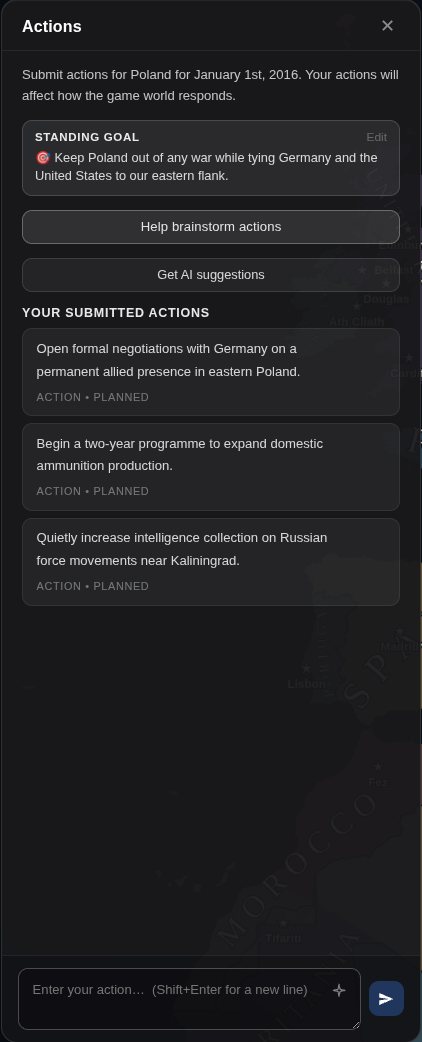 The standing goal above, the order queue below. Orders are plain English and resolve on the next time skip.
Type it into the composer at the bottom of the panel and press Enter (Shift+Enter for a new line) or the send button. It appears under Your submitted actions as planned and stays there until a turn resolves it.
You can queue as many as you like, but three or four substantial orders per turn is a sensible working number. Beyond that the world has to divide one turn's worth of attention among all of them, and each gets less.
✕ removes an order you have changed your mind about. If the order was a troop deployment that already showed on the map, deleting it also reverts that.
The standing goal
Orders are what your government does this turn. The standing goal, at the top of the panel, is the direction behind them — "keep out of the war and grow the economy", "unify Italy by 1870". Press 🎯 Set a standing goal, write it, and Save; Edit changes it later. It is locked while a turn runs.
Who hears it:
| Your advisor | Weighs its advice by it, says what brings it nearer, and says plainly when an order works against it. |
| The time skip | Treats it as a guiding philosophy, not an order: your own ministers handle the business your orders did not cover in its spirit. It never creates an action you did not order and never makes success likelier. |
| AI suggestions | Serve it where they can. |
| Foreign leaders | Never. A government's aims are its own. |
It is kept per country, so a renamed country keeps its goal, and switching country finds that country's own. Undo and Intervene leave it as it is.
The ✦ sparkle: refining a draft
Write a rough thought, press the sparkle, and it comes back as a properly formed order. Useful when you know what you want but not how to phrase it — and useful for learning what a good order looks like, because you can watch what it changes.
Nothing is committed until you queue it, so you can refine and rewrite freely.
AI suggestions
Get AI suggestions proposes orders based on your actual situation. They arrive as topic cards; clicking one queues it. Help brainstorm actions opens the advisor instead, to talk a set of orders through with you.
Worth doing on a turn where you are not sure what to attend to — the suggestions are derived from the real state of your country, so they tend to surface things you have not noticed. They are not a to-do list, and following them uncritically produces a passive campaign.
Writing orders that work
Name the thing. "Move troops" gives the world almost nothing. "Move the 3rd Armoured Division from Poznań to the Belarusian border" gives it something to simulate.
Say what you want to achieve, not what happens. You are issuing an instruction, not writing the outcome. "Launch an offensive toward Kharkiv" is an order. "Our forces take Kharkiv and the enemy collapses" is you trying to write the event, and the world will not simply agree.
Include the reason when it matters. "Raise tariffs on steel imports to protect domestic mills" and "raise tariffs on steel imports as retaliation for the port closure" lead to genuinely different consequences.
Scale the order to the jump. A single week will not deliver an industrial programme. If you order something that takes years, expect it to appear across several turns rather than complete at once.
Be willing to be specific about method. "Improve relations with Turkey" is vague. "Offer Turkey preferential terms on grain transit in exchange for backing our position at the UN" is a policy, and produces a much more interesting reply.
Don't over-order. Six orders in one turn each get a fraction of the world's attention. Two good ones beat six thin ones.
What happens at the jump
When you skip time, your planned orders are read alongside everything else going on in the world. The events that come back reference the orders they resolve, so you can see which of your instructions actually landed and what came of them.
An order does not guarantee an outcome. On Medium, orders succeed or fail on their merits; on Hard and above, a weak or vague order will fail or backfire. See starting a game for what each difficulty changes.
Orders that are not resolved this turn stay in the queue and carry forward.
On beta an order is settled once. When an event plainly carries out a queued order — sharing most of its distinctive words — the order counts as done even if the model forgot to say which order it answered, so the next skip is not told to carry it out again.
Orders that touch other systems
Some orders are executed through the game's mechanical systems rather than just narrated:
- "Deploy a spy in Germany" places a real agent, through the same rules as the Spy tab — one agent per country, three in the field, never at home — and opens its operation on the Projects board the same turn. See espionage.
- Troop orders move real units on the map, within era-appropriate ranges. See military and combat.
- Territorial outcomes move actual borders, and are checked against the game's rules about who may transfer what. See territory.
This is why phrasing matters mechanically and not just narratively: a clearly-specified order is one the game can turn into a concrete change.
Orders are not the only lever
Plenty of a campaign happens in diplomacy rather than the order queue. A conversation that talks a neighbour into an alliance does more than an order announcing that you want one. Use both.
Next
- Time and turns — resolving the queue.
- Events and history — reading the results.
- The advisor — working out what to order in the first place.
Open Historia is under active development on two channels, and this
wiki is written by hand — a page can fall behind a release. Last checked against the game on 2026-09-24 · main e62a1c55 · beta 2f48a6c2. If something
here does not match what you see in the game, trust the game and
say so on Discord.